Lighting Tower Price: Diesel vs Solar vs Hybrid Cost Drivers and Selection Guide
Upfront lighting tower price is governed by three hardware choices—power architecture, mast height, and lamp output—whereas multi-year ownership cost is governed by shift hours, fuel delivery logistics, and battery replacement cycles. For high-output night construction requiring 176,000 lm, a diesel trailer tower such as a 7 m (23.0 ft) or 9 m (29.5 ft) unit keeps acquisition cost lower than a solar-hybrid platform, while a 9 m (29.5 ft) solar or hybrid tower justifies a higher upfront price when noise ordinances, urban curfews, or remote refueling costs dominate site expenses.
Match the required lumen output and shift length first, then compare diesel purchase-plus-fuel cost against solar or hybrid upfront capital when noise limits or remote refueling raise site operating expense. Applying that rule prevents two common procurement errors: buying a lower-output solar tower for a wide excavation zone that demands 1,600 W of LED light, or paying for a 1,000 kg (2,205 lb) heavy diesel trailer when a 210–230 kg (463–507 lb) push-cart tower fits the crew and terrain.
How Light Tower Specs Drive Upfront Equipment Quotes
Lamp Output and Mast Height Tiers From 5 m (16.4 ft) to 9 m (29.5 ft)
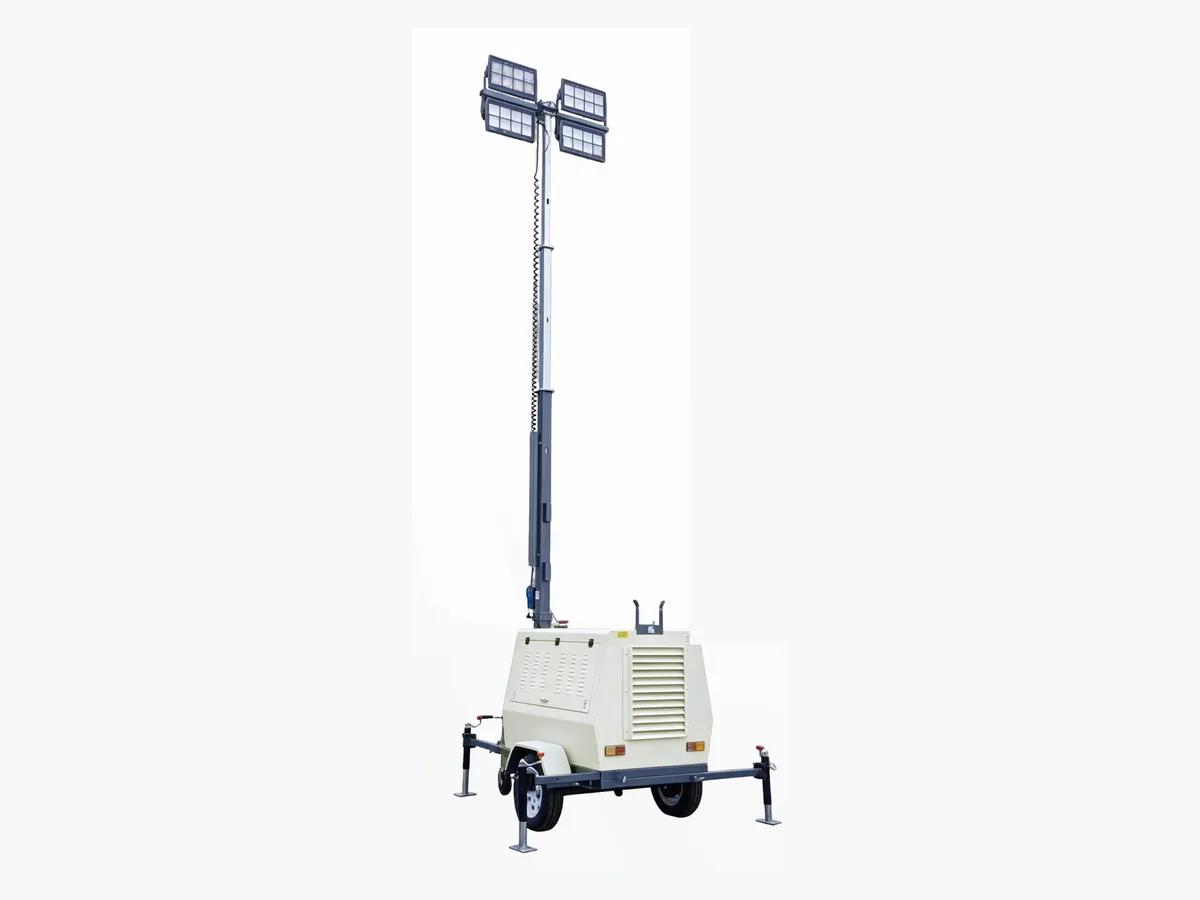
Luminous flux, measured in lumens (lm) as the total visible light emitted by a lamp head, separates diesel workhorses from solar platforms. Standard 7 m (23.0 ft) and 9 m (29.5 ft) diesel units carry four 400 W LED fixtures delivering 1,600 W total power and 176,000 lm, whereas the 9 m (29.5 ft) solar/hybrid unit carries four 200 W LED fixtures delivering 800 W total power and 88,000 lm. Because both the SZMT7-1600/4L 094 7 m diesel light tower and the SZMT9-1600/4L 095 9 m diesel light tower share the same 176,000 lm lamp head rating, a higher quote on a 9 m (29.5 ft) diesel model reflects mast elevation, water-cooled three-cylinder engine sizing, a 100 L (26.4 gal) fuel tank, and heavy trailer construction rather than brighter LEDs.
Mast height also dictates steel gauge, winch capacity, and stowed geometry. A 1.8–5 m (5.9–16.4 ft) four-section push-cart mast serves tight repair zones and indoor-adjacent maintenance bays, a 2.5–7 m (8.2–23.0 ft) seven-section mast covers general civil engineering, and a 9 m (29.5 ft) three-section or horizontal-laydown 4.6–9 m (15.1–29.5 ft) mast elevates the beam to reduce ground glare across wider yards. On the standard 094 configuration, buyers should confirm the 2.5–7 m (8.2–23.0 ft) mast assembly height on the order sheet because some brochure illustrations reference 9 m (29.5 ft).
Chassis Weight, Mobility Format, and Deployment Hardware
Running gear and frame steel represent a major share of manufacturing cost and ocean-freight volume. A compact SZMT5-1600/4L 090 5 m push-cart light tower weighs 210–230 kg (463–507 lb) depending on open-frame or silent-canopy powerplant selection, allowing one or two operators to reposition the machine manually between concrete pours or utility trenches.
Stepping up to a dual short-distance push and long-distance tow format such as the 094—with the 7 m upgraded trailer chassis rated at 457 kg (1,008 lb)—adds a towable axle, four leveling outriggers, and wider access covers for routine service. Heavy 9 m (29.5 ft) platforms, including the 095 diesel trailer and the solar/hybrid trailer, reach 1,000 kg (2,205 lb) to anchor taller masts and house larger powerplants or battery banks. Adding optional road-towing brake and turn signal lights or a horizontal-laydown mast on a 9 m (29.5 ft) build increases unit pricing further and should be specified early in the quotation request.
Specification and Cost-Driver Comparison Across Four Platforms
The manufacturer brochure supplies nominal specifications for four representative mobile light tower platforms; actual quotation prices depend on engine brand, optional packages, and order volume.
| Specification | 090 Push-Cart (SZMT5-1600/4L) | 094 Diesel (SZMT7-1600/4L) | 095 Diesel (SZMT9-1600/4L) | 9 m Solar/Hybrid (SZMT9-800/4L) |
|---|---|---|---|---|
| Mast Height Range | 1.8–5 m (5.9–16.4 ft), 4-section | 2.5–7 m (8.2–23.0 ft), 7-section | Up to 9 m (29.5 ft), 3-section | 2.5–9 m (8.2–29.5 ft), 7-section |
| Standard Lamp Output | 4×400W LED option (metal halide / balloon optional) | 4×400W LED (1,600 W, 176,000 lm) | 4×400W LED (1,600 W, 176,000 lm) | 4×200W LED (800 W, 88,000 lm) |
| Power Architecture | 4.5 or 6.5 kW gas/diesel | 4.5 kW diesel (Kubota option) | 9 / 9.5 / 11 kW 3-cyl diesel + 9 kW generator | 4×430W solar + 4×12V 200Ah gel battery + optional diesel backup |
| Fuel Tank Capacity | 12.5 L (3.3 gal) | 48 L (12.7 gal) external tank | 100 L (26.4 gal) | Optional diesel backup only |
| Mobility and Weight | Push-cart, 210–230 kg (463–507 lb) | Push + tow, 4 outriggers (7 m upgraded chassis 457 kg / 1,008 lb) | Trailer, 4 outriggers, 1,000 kg (2,205 lb) | Trailer, 4 outriggers, 1,000 kg (2,205 lb) |
| Commercial Role | Compact frequent-move sites | Core volume 7 m diesel unit | Core volume 9 m long-shift diesel unit | Zero-exhaust, lower-fuel-dependence unit |
Why Solar Tower Light Price Sits Above Standard Diesel Units
Photovoltaic Panels, Gel Battery Banks, and Slide-Rail Framing
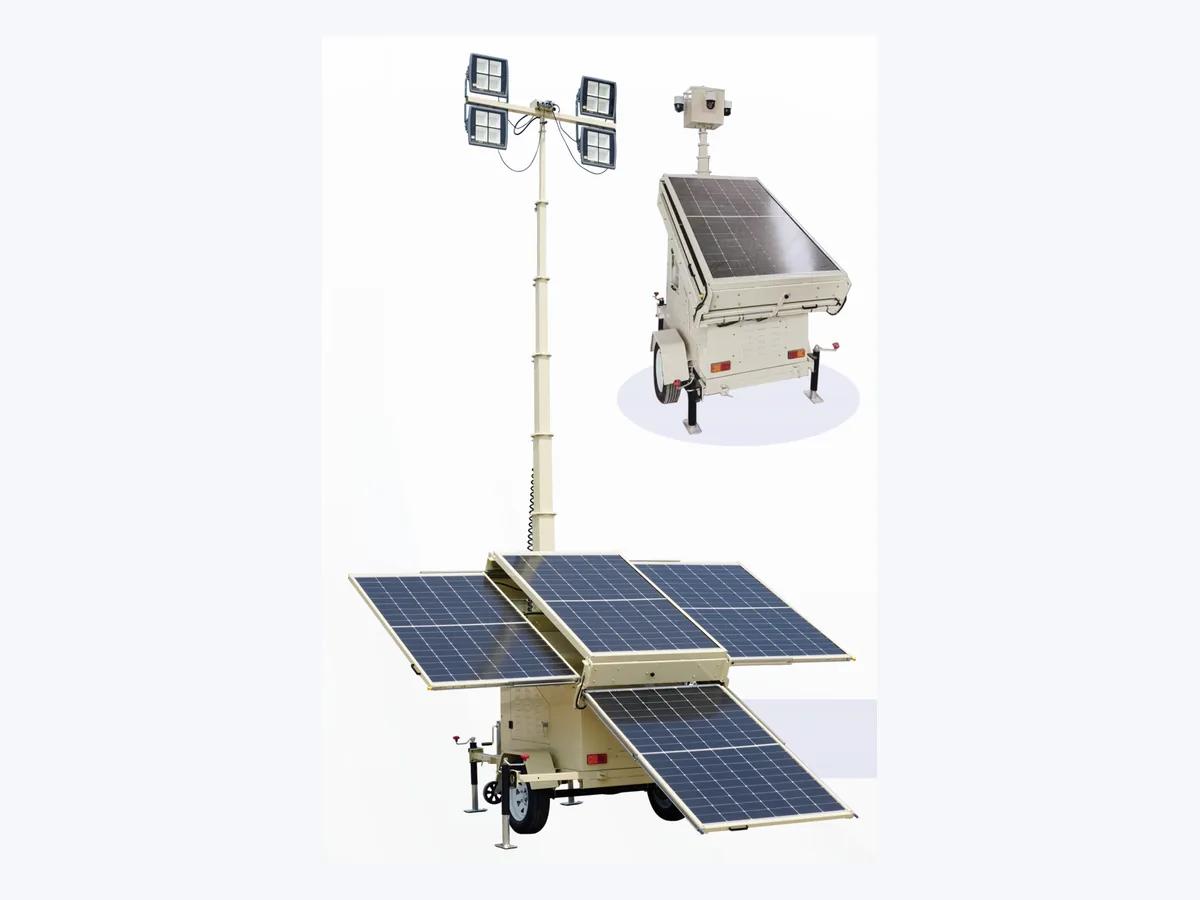
A higher solar tower light price stems from energy-capture and energy-storage hardware added on top of a full 1,000 kg (2,205 lb) trailer frame. On the SZMT9-800/4L 9 m solar hybrid light tower, four 430 W photovoltaic panels mount on slide-out rails so crews can stow the array inside the trailer footprint during transit and extend it on site. Beneath the deck, four 12 V 200 Ah gel batteries store daytime solar harvest. A gel battery is a sealed, maintenance-free lead-acid battery that uses a silica gel electrolyte to reduce acid spills and remove routine water-topping service.
Together, the slide-rail panel structure, solar charge controller, and four-battery bank add substantial bill-of-materials cost compared with a compact 4.5 kW diesel generator. Buyers pay that premium upfront to cut routine refueling trips, reduce engine oil and filter maintenance, and run low-noise, zero-exhaust lighting while operating from battery power.
Illumination Trade-Offs and Optional Diesel Hybrid Backup
Evaluating a solar platform strictly on zero-fuel savings overlooks two structural limits that affect jobsite coverage. First, the 4×200W LED array produces 88,000 lm—half the 176,000 lm output of the 1,600 W diesel towers—so wide earthmoving or quarry zones may require closer unit spacing to achieve the same task illumination. Second, the larger surface area of the deployed solar array carries a Beaufort scale 6 wind rating, whereas the 7 m (23.0 ft) diesel 094 carries a Beaufort scale 8 rating. The Beaufort scale is a standardized wind-force index in which level 6 corresponds to strong breeze conditions and level 8 corresponds to gale-force winds.
Sites that experience multi-day cloud cover or winter daylight shortages should specify the optional diesel backup generator (hybrid mode) on the SZMT9-800/4L. Request a project-specific solar charging and battery autonomy calculation for the destination latitude and season before relying on standalone solar operation for overnight shifts.
Evaluating Light Tower Fuel Consumption and Tank Autonomy
Tank Capacity Scaling Across Shift Profiles
Over a multi-year fleet lifecycle, diesel expense and technician refueling trips often outweigh initial purchase price differences. Fuel tank volume directly controls refueling intervals: the 090 push-cart holds 12.5 L (3.3 gal) for short repair windows, the 094 holds an external 48 L (12.7 gal) tank suited to multi-shift standard construction, and the 095 holds a 100 L (26.4 gal) tank engineered for extended remote deployment.
The manufacturer feature sheet for the 9 m (29.5 ft) diesel platform cites a nominal 36-hour runtime on the 100 L (26.4 gal) tank, while engine specification rows display 38, 40, and 40 across engine options with load conditions and units confirmed at quotation. Fleet buyers modeling light tower fuel consumption should confirm measured liters-per-hour burn rates at full 1,600 W LED load during quotation to size refueling schedules accurately across different engines and auxiliary outlet loads.
Engine Power Sizing and Refueling Labor Costs
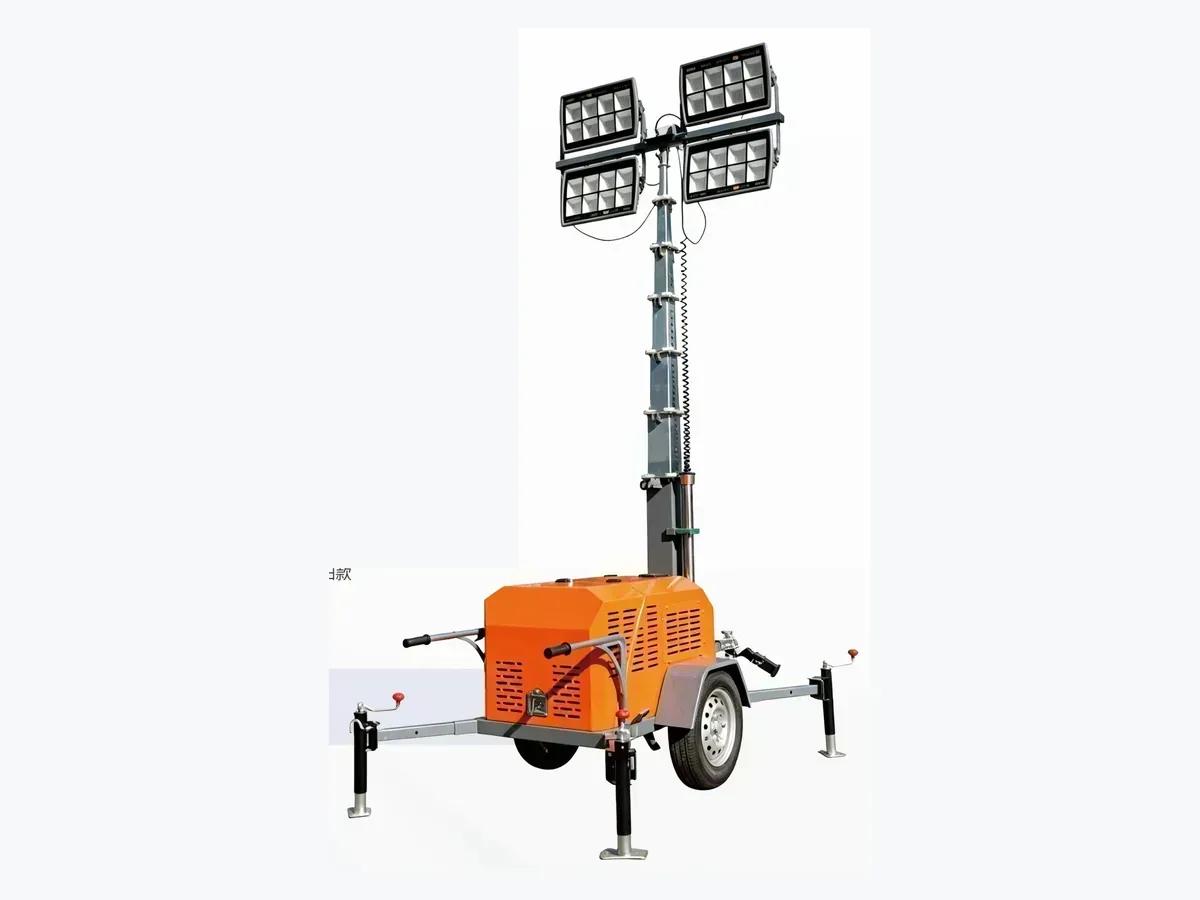
Engine architecture bridges acquisition price and fuel reliability. Compact 4.5 kW diesel engines on 7 m (23.0 ft) units lower upfront purchase cost, whereas 9 m (29.5 ft) trailers step up to water-cooled three-cylinder diesel engines—Quanchai 11 kW, Yanmar 9 kW, or Kubota 9.5 kW—paired with a 9 kW rated generator for continuous-duty thermal stability. For a detailed breakdown of how those three engines compare on service networks, generator headroom, and fleet durability, review the Yanmar, Kubota, and Quanchai diesel light tower engine guide.
When a project requires frequent repositioning or tighter wind margins alongside fuel budgeting, mast height also affects which trailer chassis is viable; see the 7 m vs 9 m telescopic light tower mast selection guide for structural and clearance trade-offs.
Matching Fleet Procurement Strategy to Jobsite Constraints
Rental Fleet Standardization and Resale Liquidity
Equipment rental companies and wholesale distributors typically split fleet purchases into a volume diesel tier and a specialized zero-exhaust tier. On the rental fleet wholesale application page and the full mobile light tower product catalog, the 094 (7 m / 23.0 ft) and 095 (9 m / 29.5 ft) act as core volume diesel models because they deliver 176,000 lm with familiar manual-winch operation and straightforward canopy access. The 9 m (29.5 ft) solar/hybrid unit fills a specialized quiet tier for municipal night work, commercial events, and noise-sensitive urban corridors where diesel exhaust or engine sound triggers site penalties.
Custom paint colors are available across multiple models, helping rental yards standardize fleet identity without altering mechanical spare parts. Standardizing on one engine brand across 9 m (29.5 ft) trailers also simplifies filter stocking and improves resale value at the end of the rental depreciation cycle.
Commercial Quotation Factors Beyond Base Unit Cost
Landed cost per unit depends heavily on shipping density and regional options. Because a 210–230 kg (463–507 lb) push-cart tower occupies far less container floor space than a 1,000 kg (2,205 lb) trailer, freight cost per lamp tower scales steeply with chassis size. Optional upgrades—such as high-temperature cooling packages or Kubota engines on the 094, horizontal-laydown masts with brake and turn signal lights on 9 m (29.5 ft) builds, or metal halide and balloon lamp heads on the 090—change both lead time and landed unit price. Confirm regional electrical voltage, frequency (50 Hz or 60 Hz), road-towing lighting rules, and any destination compliance documents required by local inspectors before issuing a purchase order.
FAQS
Does a 9 m (29.5 ft) diesel light tower produce more light than a 7 m (23.0 ft) diesel model?
No. Both the 7 m (23.0 ft) SZMT7-1600/4L (094) and the 9 m (29.5 ft) SZMT9-1600/4L (095) use four 400 W LED heads rated at 1,600 W total and 176,000 lm. The 9 m (29.5 ft) model elevates those lamps 2 m (6.6 ft) higher to broaden beam projection and reduce glare, while adding a water-cooled three-cylinder engine, a 100 L (26.4 gal) fuel tank, and a 1,000 kg (2,205 lb) trailer chassis.
When does a higher solar tower light price pay back compared with diesel?
Payback is fastest on noise-restricted urban jobsites, long-term semi-permanent security perimeters, and remote locations where fuel delivery trucks are expensive to dispatch. Where projects require full 176,000 lm output across wide earthworks or run long winter shifts with limited sunlight, a diesel or hybrid configuration avoids under-lighting the site.
What is the difference between a pure solar tower and a solar hybrid light tower?
A pure solar tower charges its 4×12V 200Ah gel battery bank exclusively from its 4×430W photovoltaic panels. A hybrid configuration adds an optional diesel backup generator to the SZMT9-800/4L platform, allowing crews to recharge batteries or sustain illumination during extended cloudy weather or high-demand overnight shifts.
How should buyers compare fuel runtime across the 090, 094, and 095 diesel models?
Start with tank volume: 12.5 L (3.3 gal) on the 090, 48 L (12.7 gal) on the 094, and 100 L (26.4 gal) on the 095 (with a nominal 36-hour rating on the 9 m feature sheet). Request measured hourly fuel consumption at full 1,600 W LED load for the exact engine option selected so refueling schedules match site shift lengths.
Are push-cart towers like the 090 suitable for highway towing?
No. The SZMT5-1600/4L (090) at 210–230 kg (463–507 lb) is designed as a manual push-cart for frequent on-site repositioning. For tow-behind transport between jobsites, select a trailer-mounted platform such as the 094 or 095 and confirm local road-towing lighting and axle requirements on the order.
What affects container freight cost when importing mobile light towers?
Chassis dimensions, mast stowage geometry (vertical three-section mast versus optional horizontal-laydown mast), and curb weight from 210–230 kg (463–507 lb) up to 1,000 kg (2,205 lb) determine how many units fit inside a 20 ft or 40 ft shipping container. Confirm knocked-down or assembled loading plans with the factory during quotation.