Light Tower Mast Selection: 7 m vs 9 m Telescopic Masts, Wind Stability, and LED Heads
Choosing between a 7 m (23.0 ft) and a 9 m (29.5 ft) light tower mast does not change total lamp brightness on 1,600 W diesel platforms: both carry four 400 W LED heads rated at 176,000 lm. Instead, mast height determines beam elevation angle, operator glare control, stowed transport clearance, wind stability, and the trailer weight required to anchor the extended tower.
Select a 7 m (23.0 ft) manual-winch mast for compact jobsite mobility and Beaufort level 8 wind stability, and step up to a 9 m (29.5 ft) mast when wider elevated illumination and 100 L (26.4 gal) long-shift autonomy outweigh a 1,000 kg (2,205 lb) trailer footprint. Applying that rule keeps crews from hauling oversized trailers into tight urban sites or deploying short masts where elevated beam clearance is needed over equipment and stockpiles.
Comparing 7 m (23.0 ft) and 9 m (29.5 ft) Telescopic Light Mast Geometry
Section Count, Stowed Height, and Elevation Mechanics
A telescopic light mast consists of nested metal tubes that extend vertically using a manual hand winch and steel lifting cable, eliminating hydraulic hoses and pump leaks on dusty sites. Section count governs how compactly the mast stows during transit and storage.
Across the four standard platforms, mast geometry scales directly with chassis format. The compact SZMT5-1600/4L 090 5 m push-cart light tower extends from 1.8 m to 5 m (5.9 to 16.4 ft) across four sections. The SZMT7-1600/4L 094 7 m diesel light tower extends from 2.5 m to 7 m (8.2 to 23.0 ft) across seven sections; confirm the standard 2.5–7 m (8.2–23.0 ft) mast assembly height on the order sheet because some brochure illustrations reference 9 m (29.5 ft). For full 9 m (29.5 ft) elevation, the SZMT9-1600/4L 095 9 m diesel light tower uses a rigid three-section mast, with an optional 4.6–9 m (15.1–29.5 ft) horizontal-laydown mast on the 9 m upgraded build, while the SZMT9-800/4L 9 m solar hybrid light tower uses a seven-section 2.5–9 m (8.2–29.5 ft) manual-lift mast.
Wind Resistance Ratings and Four-Outrigger Leveling
Wind resistance depends on mast height, cross-sectional sail area, and base footprint. The Beaufort scale is a standardized wind-force index in which level 6 represents strong breeze conditions and level 8 represents gale-force winds. On open construction site lighting deployments, the 7 m (23.0 ft) 094 diesel tower is rated for Beaufort scale 8 wind resistance, whereas the 9 m (29.5 ft) SZMT9-800/4L solar tower is rated for Beaufort scale 6 because its taller elevation and slide-rail photovoltaic panels present greater wind load.
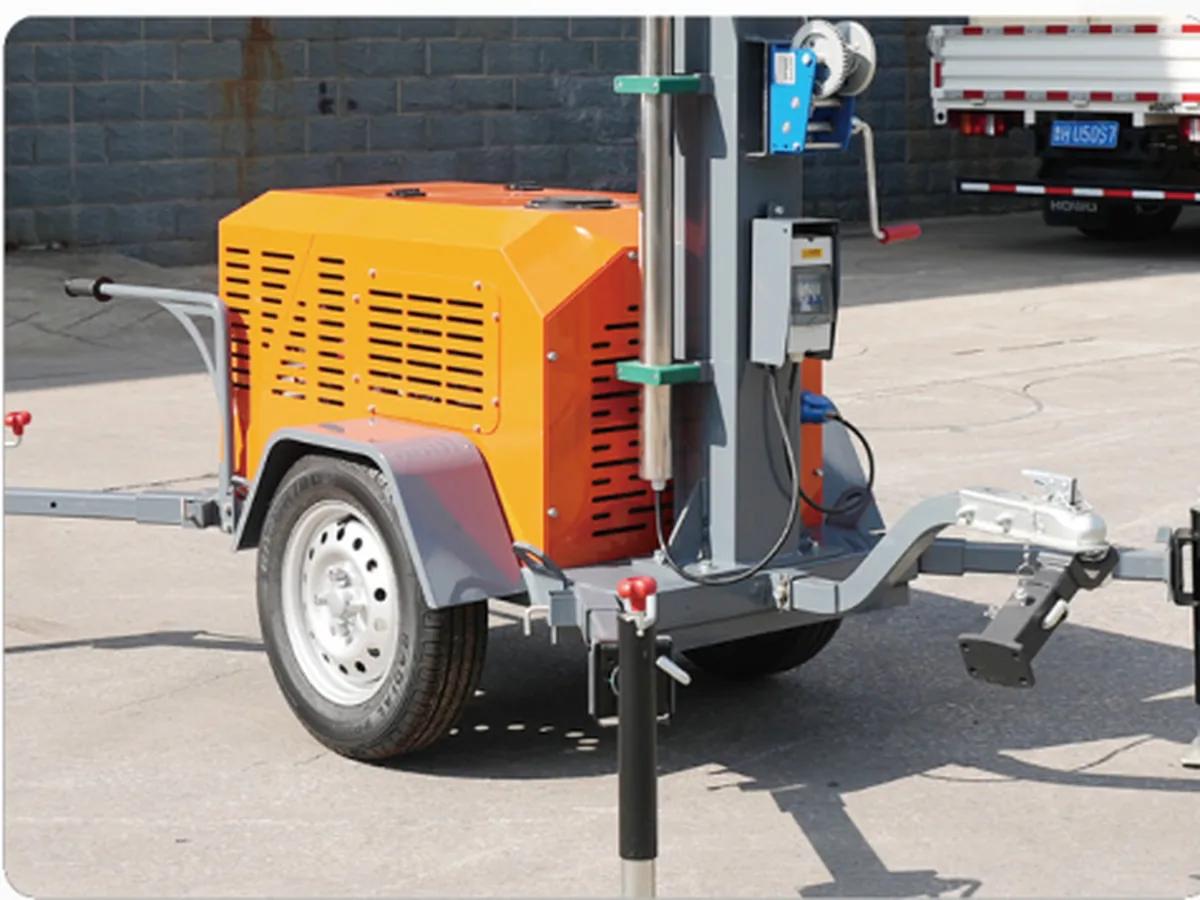
Both 7 m (23.0 ft) and 9 m (29.5 ft) trailer units rely on four leveling outriggers to widen the support stance and keep the mast plumb on graded gravel or sloped road shoulders. On the 5 m (16.4 ft) 090 push-cart, confirm site-specific wind limits with the factory at order rather than assuming a Beaufort level 6 rating.
Mast Height, Chassis Weight, and Lamp Configuration Comparison
| Model | Mast Height Range | Section Count and Lift | Wind Rating | Mobility and Weight | Lamp Output |
|---|---|---|---|---|---|
| 090 Push-Cart (SZMT5-1600/4L) | 1.8–5 m (5.9–16.4 ft) | 4-section manual winch | Confirm at order | Push-cart, 210–230 kg (463–507 lb) | 4×400W LED option (metal halide / balloon optional) |
| 094 Diesel (SZMT7-1600/4L) | 2.5–7 m (8.2–23.0 ft) | 7-section manual winch | Beaufort scale 8 | Push + tow, 4 outriggers (7 m upgraded chassis 457 kg / 1,008 lb) | 4×400W LED (1,600 W, 176,000 lm) |
| 095 Diesel (SZMT9-1600/4L) | Up to 9 m (29.5 ft) (4.6–9 m / 15.1–29.5 ft laydown option) | 3-section manual winch | Confirm per build | Trailer, 4 outriggers, 1,000 kg (2,205 lb) | 4×400W LED (1,600 W, 176,000 lm) |
| 9 m Solar/Hybrid (SZMT9-800/4L) | 2.5–9 m (8.2–29.5 ft) | 7-section manual lift | Beaufort scale 6 | Trailer, 4 outriggers, 1,000 kg (2,205 lb) | 4×200W LED (800 W, 88,000 lm) |
Matching a Tow Behind Light Tower Chassis to Site Access
Push-Cart vs Dual Push-and-Tow vs Full Trailer Formats
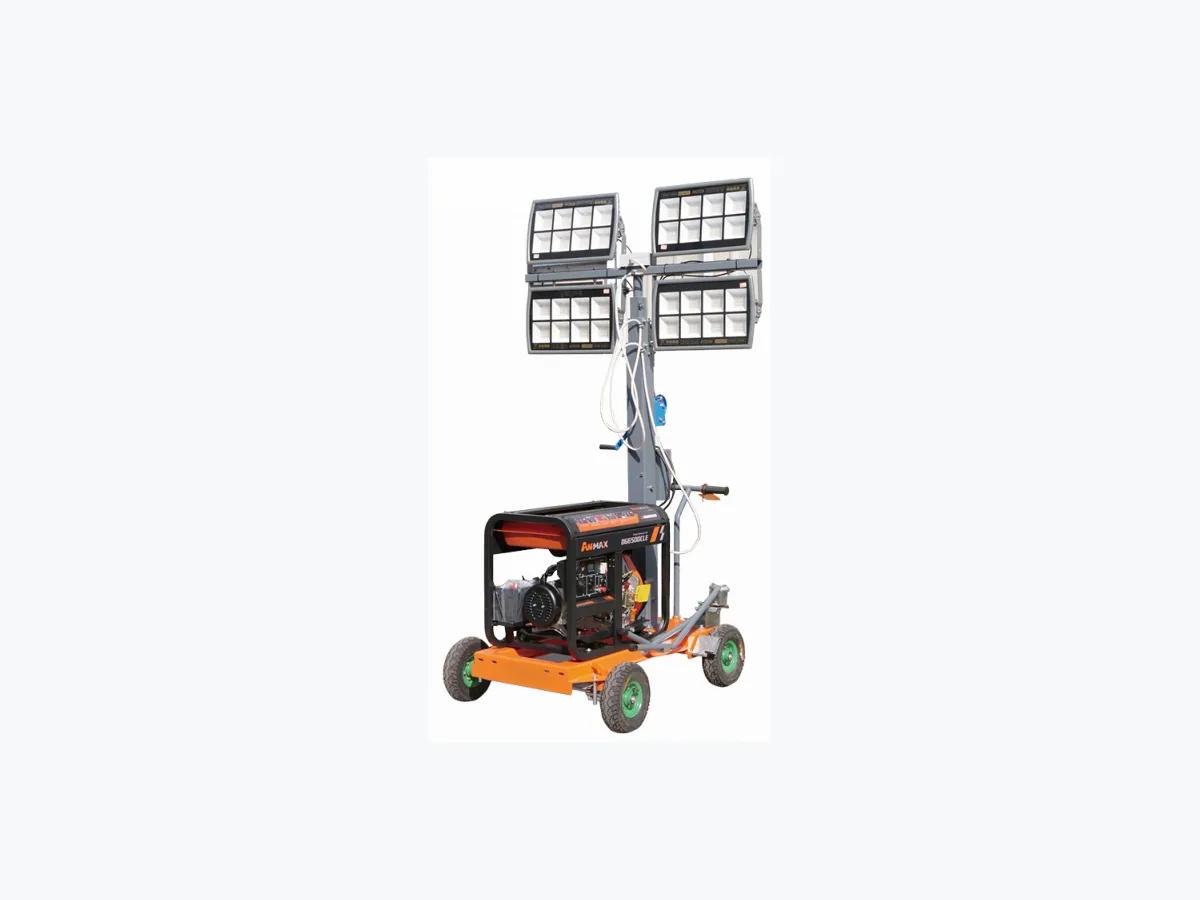
Site access determines whether a crew benefits from a compact hand-moved frame or a dedicated tow behind light tower. At 210–230 kg (463–507 lb), the 090 push-cart rolls through narrow utility gates, bridge walkways, and indoor-adjacent maintenance zones where tow vehicles lack turning radius.
Mid-size civil projects often favor the 094 because its dual chassis supports short-distance hand pushing around active concrete forms and long-distance towing between job phases, with the 7 m upgraded trailer chassis weighing 457 kg (1,008 lb). Full 9 m (29.5 ft) platforms—both the 095 diesel trailer and the solar/hybrid trailer—weigh 1,000 kg (2,205 lb), requiring a dedicated tow vehicle and firmer staging ground in exchange for taller beam projection and a 100 L (26.4 gal) fuel tank on the diesel build.
Transport Clearance, Horizontal-Laydown Masts, and Road Lighting
Stowed mast height affects garage doorways, low utility lines, and shipping container loading. A vertical three-section 9 m (29.5 ft) mast stows taller than a seven-section 2.5–7 m (8.2–23.0 ft) mast; buyers who transport units frequently over public roads or under low structures should consider the optional 4.6–9 m (15.1–29.5 ft) horizontal-laydown mast with brake and turn signal lights available on the 9 m upgraded configuration. For how chassis and mast choices interact with unit pricing and engine weight, review the diesel vs solar vs hybrid lighting tower price guide and the Yanmar, Kubota, and Quanchai diesel light tower engine comparison.
Planning LED Light Tower Replacement Lights and Lamp Head Upgrades
Comparing 4×400W Diesel LED Arrays Against 4×200W Solar Heads
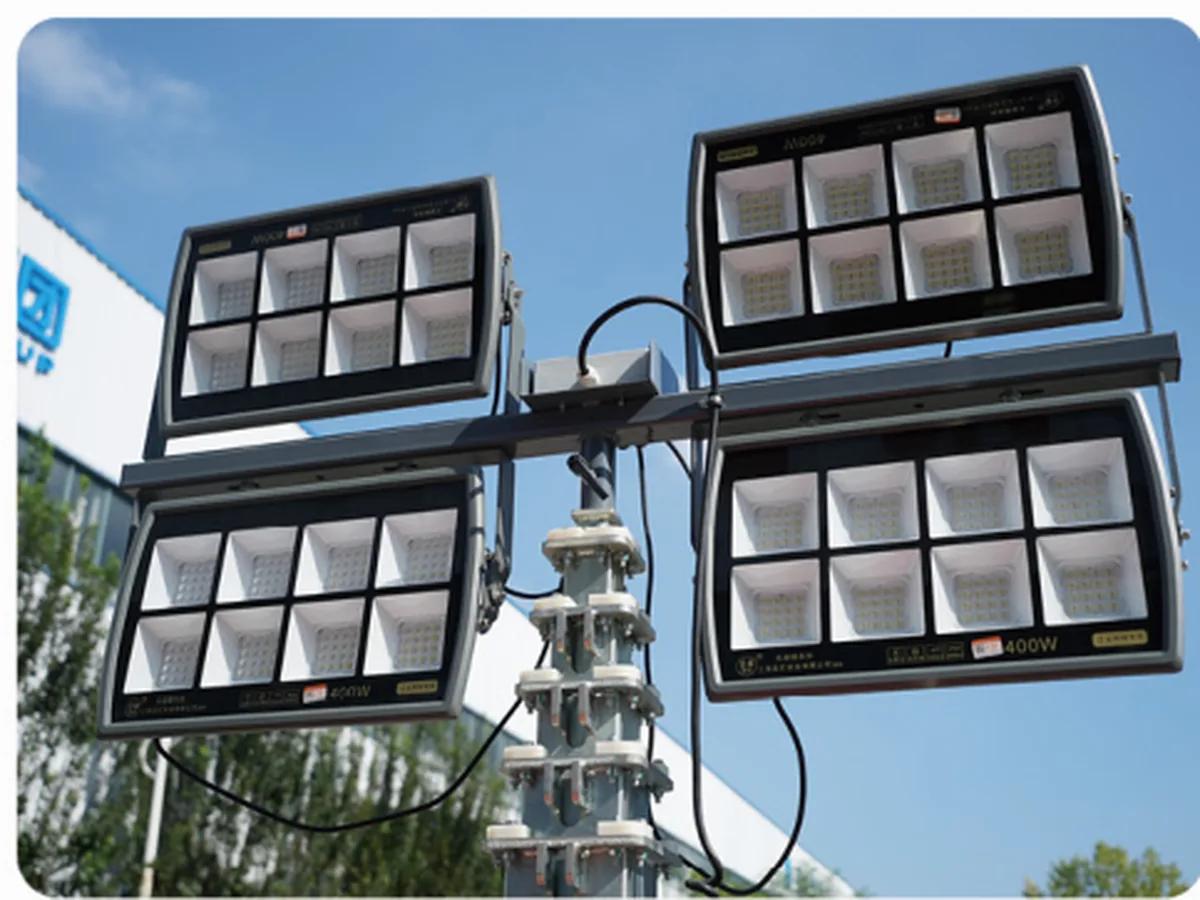
Luminous flux, measured in lumens (lm) as total visible light emitted by a fixture, anchors lamp-head replacement planning. Both the 7 m (23.0 ft) 094 and the 9 m (29.5 ft) 095 diesel units mount four 400 W LED heads (1,600 W total, 176,000 lm), whereas the 9 m (29.5 ft) SZMT9-800/4L solar/hybrid unit mounts four 200 W LED heads (800 W total, 88,000 lm) to align power draw with battery storage.
Because each lamp head tilts and swivels on the mast crossbar, operators can direct light onto a trench, loading apron, or road lane. Adjustable aiming does not automatically deliver uniform 360-degree illumination; verify lamp aiming patterns on site and note that the 7 m upgraded configuration supports independent lamp-head switching when partial lighting is sufficient.
LED vs Metal Halide and Balloon Lamp Compatibility
Fleet maintenance teams sourcing LED light tower replacement lights—or converting older metal halide heads—must match electrical and mechanical parameters before ordering fixtures. While LED is the primary lamp configuration across the lineup, optional metal halide heads and diffused balloon lamps remain available by order on platforms such as the 090 push-cart.
When specifying replacement LED heads, confirm four parameters against the existing mast crossbar and generator panel: individual fixture wattage (200 W versus 400 W), input voltage and electrical frequency (50 Hz or 60 Hz), mounting bracket bolt spacing, and coiled mast-cable current rating. Matching those values prevents driver failure and keeps mast head weight within manual-winch limits.
Jobsite Inspection and Safe Mast Operation Practices
Pre-Elevation Checks for Winch Cables, Outriggers, and Overhead Clearance
Before cranking any manual-winch telescopic mast to 7 m (23.0 ft) or 9 m (29.5 ft), deploy and lock the four outriggers on firm, level ground so the trailer chassis sits stable and plumb. Inspect overhead space for power lines, crane booms, and bridge soffits across the full 9 m (29.5 ft) extension path. Verify that winch safety pawls engage cleanly and that coiled lamp cables hang free without snagging on mast collars.
Preventive Maintenance for Mast Slides and Cable Routing
Dust, mud, and concrete splatter accelerate wear inside seven-section and three-section telescoping channels. Wipe exposed mast tubes clean before lowering after muddy shifts, check steel winch cables for fraying or kinks, and inspect coiled power cords for jacket cracking at each bend point. Lower and lock the mast fully before towing the trailer or when site winds approach the platform's rated Beaufort scale limit.
FAQS
Is a 9 m (29.5 ft) light tower mast brighter than a 7 m (23.0 ft) mast?
No. On the 094 (7 m / 23.0 ft) and 095 (9 m / 29.5 ft) diesel platforms, both towers run four 400 W LED heads rated at 1,600 W total and 176,000 lm. Raising the lamps from 7 m (23.0 ft) to 9 m (29.5 ft) improves downward beam angle and reduces horizontal glare for equipment operators rather than increasing total lumens.
Why does the 7 m (23.0 ft) 094 have a higher wind rating than the 9 m (29.5 ft) solar tower?
The 094 diesel tower stands 2 m (6.6 ft) lower and carries no extended solar panels, earning a Beaufort scale 8 wind rating. The 9 m (29.5 ft) SZMT9-800/4L solar tower stands taller and deploys four 430 W slide-rail photovoltaic panels that catch more wind force, resulting in a Beaufort scale 6 wind rating.
What is the advantage of a horizontal-laydown mast on a 9 m (29.5 ft) tow-behind light tower?
An optional 4.6–9 m (15.1–29.5 ft) horizontal-laydown mast lowers stowed transport height and pairs with brake and turn signal lights on the 9 m upgraded configuration, making highway-style towing under low bridges and container loading easier than a tall vertical-stow mast.
Can one person move a 7 m (23.0 ft) or 5 m (16.4 ft) light tower on site without a truck?
The 5 m (16.4 ft) 090 push-cart weighs 210–230 kg (463–507 lb) and is built specifically for manual repositioning on flat surfaces. The 7 m (23.0 ft) 094 supports short-distance hand pushing alongside long-distance towing, whereas 1,000 kg (2,205 lb) 9 m (29.5 ft) trailers require a tow vehicle.
What details are required when ordering LED light tower replacement lights?
Confirm the fixture wattage (200 W for solar builds or 400 W for 1,600 W diesel builds), supply voltage and frequency (50 Hz or 60 Hz), crossbar bracket dimensions, and connector or coiled-cable specifications so replacement heads fit safely within winch load limits.
Why do some brochure pages reference 9 m (29.5 ft) on the 094 model?
The 094 specification table establishes 2.5–7 m (8.2–23.0 ft) as the standard seven-section mast height, while certain brochure illustrations reference 9 m (29.5 ft). Confirm the exact mast assembly height (7 m / 23.0 ft versus 9 m / 29.5 ft) in writing on the order sheet before production.